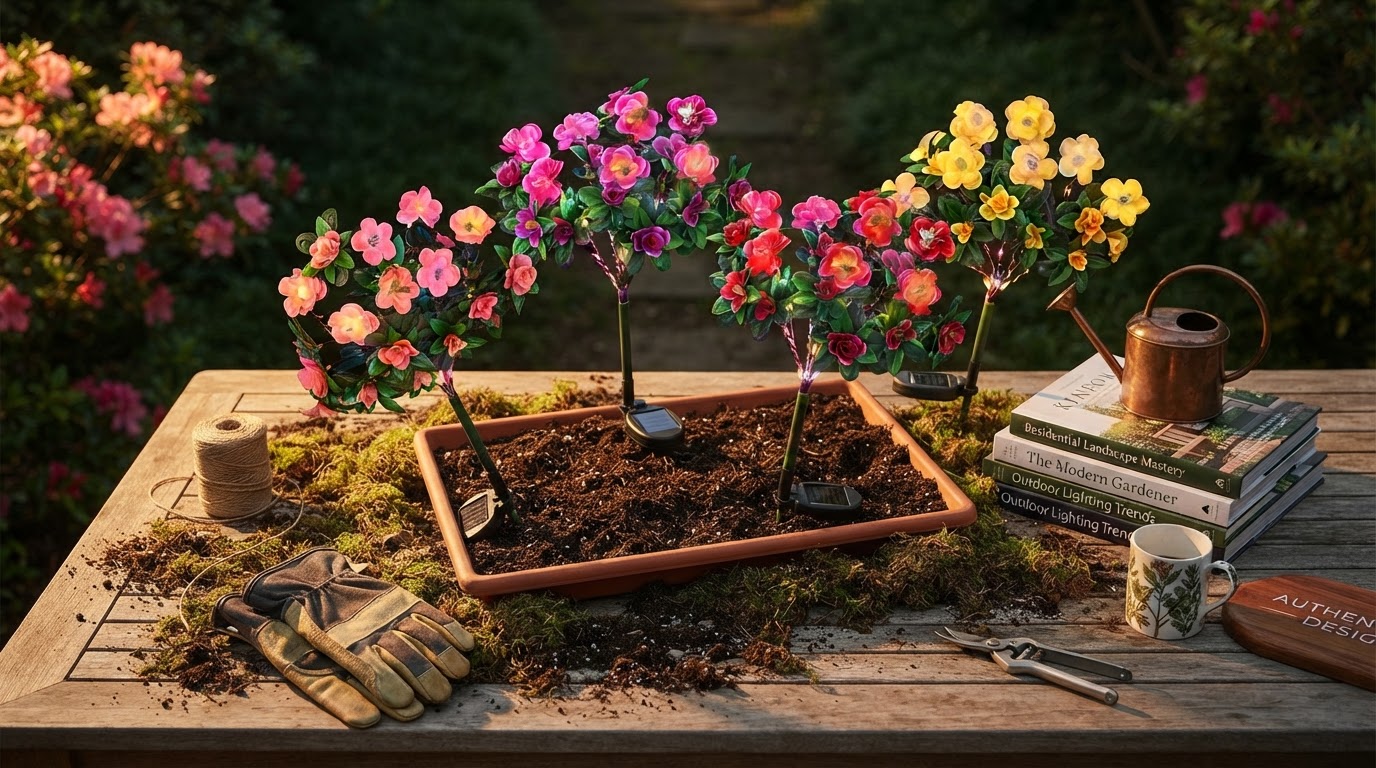
Solar Azalea Lights for Landscape Design
 Maya ChenContributing Editor
October 29, 2026. This evaluation examines the technical viability and aesthetic integration of solar powered landscape flowers within residential environments. It is intended for homeowners and landscape designers seeking to balance low-maintenance automation with visual authenticity.
The Limitations of Traditional Landscape Lighting
The conventional wisdom says that high-voltage wired lighting is the only way to achieve a professional-grade landscape aesthetic. However, the labor costs and permanent disruption to soil health required for trenching cables often negate the benefits for established gardens. According to Outdoor Solar Outlet, solar flower lights are now positioned as ideal alternatives for garden beds, landscape borders, and pathways because they eliminate the need for electrical infrastructure. Yet, the market is saturated with low-quality polymer replicas that fail to withstand UV exposure or provide sufficient lumen output for safety. Most consumers accept a trade-off: they either get durable but industrial-looking spotlights, or delicate floral accents that disintegrate after one season. Here's the part nobody talks about: the majority of solar powered landscape flowers fail not because of the battery, but because of poor thermal management in the petal housing. When heat builds up within the LED casing, it degrades the luminosity of the diode. For those seeking realistic solar floral lights, the focus must shift from pure lumen count to the quality of the light diffusion materials. Relying on generic string lights often results in a cluttered look, whereas outdoor solar azalea stake lights offer a structured architectural element that maintains its form during daylight hours. The industry standard for IP ratings is often cited as IP44, but for a landscape light to survive consistent irrigation and storm surges, IP65 is the minimum acceptable threshold for long-term deployment.
Technical Advantages of Solar Azalea Lights
Solar Azalea Lights address the primary failure points of the category by utilizing high-efficiency monocrystalline silicon panels and weather-resistant fabrications. While many competitors utilize polycrystalline panels that struggle in partial shade, these units are designed to maximize energy conversion even in the dappled light common under garden canopies. Run the math: a standard 600mAh Ni-Mh battery, as noted by Solar-US-Shop, requires approximately 6 to 8 hours of direct sunlight to provide 8 to 10 hours of illumination. Solar Azalea Lights optimize this cycle by utilizing low-draw LED components that maintain consistent color temperatures throughout the discharge cycle. This prevents the dimming effect seen in cheaper alternatives where the light shifts to a sickly blue-white as the battery drains. Furthermore, the structural design of these lights mimics the natural branching of the Azalea genus, providing a visual density that realistic solar floral lights often lack. By integrating the solar collector lower on the stake or using a remote tethered panel, the design avoids the top-heavy 'lolipop' look that plagues inferior models. The use of outdoor solar azalea stake lights allows for a tiered lighting strategy, where the floral heads provide mid-level illumination while the stems blend into existing foliage. This specific form factor is critical for those who want their solar powered landscape flowers to look like intentional horticultural choices rather than plastic novelties. The durability of the petal material is also a differentiator; rather than thin plastic that yellows, these use UV-stabilized treated fabrics that retain their pigment under intense sun exposure.
A Framework for Landscape Integration
Integrating solar powered landscape flowers requires more than just random placement; it requires a systematic approach to light layering and solar access. Before purchasing, one must assess the micro-climates of the garden. A common mistake is placing outdoor solar azalea stake lights in northern-facing shadows where they will never reach full charge, leading to premature battery sulfation. When selecting realistic solar floral lights, prioritize units that offer modularity—the ability to replace the battery cell without discarding the entire fixture. This is the only way to ensure the product remains sustainable over a three-to-five-year horizon. I’ll change my mind when a manufacturer proves that a $5 plastic stake can outlast a winter freeze, but until then, the focus must remain on high-grade components. When evaluating your landscape, use the following technical checklist:
- Verify the ingress protection (IP) rating is at least IP65 to ensure protection against rain and dust.
- Confirm the battery chemistry is Ni-Mh or LiFePO4 for better thermal stability compared to older Ni-Cd cells.
- Map the garden's daily sun exposure to ensure the solar panels receive at least 6 hours of unobstructed light.
- Select a color temperature (ideally 2700K to 3000K) that complements the natural greenery rather than clashing with it.
- Evaluate the stake material for corrosion resistance, specifically looking for powder-coated aluminum or reinforced ABS plastic.
- Check for automatic dusk-to-dawn sensors to eliminate the need for manual operation.
Sources
- Solar Floral Lights - Outdoor Solar Outlet
- Solar Flower Garden - Pinterest
- Solar Flowers 4-Color Lights & 2 Lightning Modes - Review - YouTube