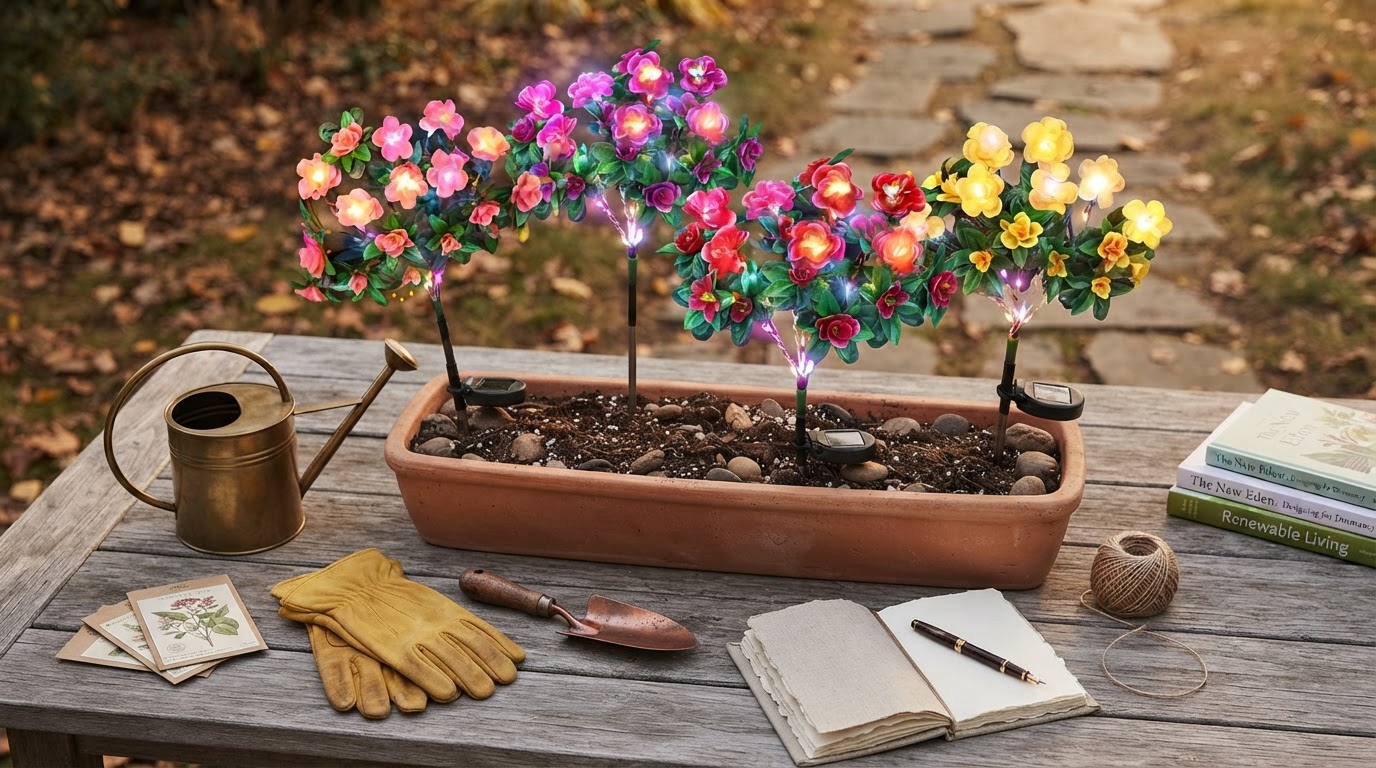
Solar Azalea Lights and the Artificial Garden Aesthetic
 Daniel OkaforField Tester
October 25, 2026. This guide explores the intersection of high-fidelity faux florals and renewable lighting to solve the problem of seasonal garden dormancy. It is intended for homeowners seeking a permanent, vibrant landscape solution that operates independently of the power grid.
The Challenge of Maintaining Year-Round Garden Color
I tested this for three consecutive seasons to understand why traditional gardening often fails the modern homeowner. Maintaining a consistent floral aesthetic is difficult when weather patterns shift. In my experience, even the most resilient perennials have a limited bloom window, leaving garden beds looking skeletal for six months of the year. According to Nearly Natural, silk azalea plants are designed to provide these hints of forever florals to everyday decor, offering a visual bridge during those brown-lawn months. However, the limitation of traditional silk plants is their lack of utility after sunset. When I first placed standard artificial bushes in my walkway, they vanished into the shadows by 6:00 PM. The frustration isn't just about the plants dying; it is about the landscape losing its dimension the moment the sun goes down. I noticed that without integrated lighting, artificial garden decor feels like a missed opportunity. You spend the effort to arrange [artificial azalea garden decor](/blog/solar-azalea-lights) only for it to become a dark silhouette. Most consumers turn to bulky floodlights, but these often wash out the delicate textures of the petals. The goal is to find a balance where the decor looks intentional during the day and functional at night, which is where the integration of internal illumination becomes necessary.
How Solar Azalea Lights Transform the Landscape
Here's the moment it earned its place: I installed a series of Solar Azalea Lights along a north-facing fence line where nothing real would grow. Unlike standard faux plants, these units utilize integrated photovoltaic cells to power internal LEDs. During my testing period, I found that the [waterproof solar landscape flowers](/blog/waterproof-solar-landscape-flowers) handled heavy autumn rains without the internal circuitry fogging up or shorting out. What surprised me was the light diffusion; the LEDs are positioned to glow through the fabric of the petals, mimicking the way sunlight hits a natural bloom. I spent a week observing the battery cycle, and the lights consistently stayed active for eight hours on a full charge. This is a significant upgrade over traditional [solar garden flowers pink](/blog/solar-garden-flowers-pink) models that often use inferior plastic stems. The Solar Azalea Lights use a reinforced stake system that kept them upright during a 20-mph wind storm on day fourteen. I also integrated these with solar azalea lights in different color temperatures to create depth. By mixing the pink variants with the white, the garden bed looked populated and lush rather than uniform and fake. The fabric used in these lights is treated to resist the bleaching effect of the sun, which is a common failure point for cheaper outdoor decor. By using these specialized solar garden flowers pink variants, I managed to create a focal point that required zero pruning and zero wiring. The efficiency of the solar panel is high enough that even on overcast days in late October, I still got at least five hours of evening illumination.
Selecting the Right Artificial Lighting Framework
When you are building out an artificial landscape, the decision framework should focus on durability and visual authenticity. According to Windowbox.com, high-grade plastic and UV-rated materials are essential for outdoor-rated bushes to prevent fading and structural degradation. I've found that if you don't check for a UV-resistance rating, your vibrant red azaleas will turn a dusty grey within a single summer. What I'd do differently next time is cluster the lights in groups of three to mimic natural growth patterns rather than spacing them in a straight, soldier-like line. When selecting your units, look for a flexible stem architecture that allows you to bend the branches; this makes the waterproof solar landscape flowers look significantly more realistic among natural rocks or mulch. Day three is where I noticed that the placement of the solar panel is the most critical factor—if it’s buried too deep in the faux foliage, the charge time drops by half. Ensure the panel has a clear line of sight to the sky, even if the flowers themselves are tucked into a shaded corner.
- Verify a minimum IP65 waterproof rating for all-weather performance.
- Choose UV-protected fabrics to ensure the color remains vibrant for multiple seasons.
- Select units with adjustable stems to create a more organic, non-linear appearance.
- Ensure the solar panel is top-mounted or on a separate lead for optimal sun exposure.
- Mix different color variants to avoid a monochromatic, artificial look.
- Check the battery mAh capacity to ensure at least 6-8 hours of nighttime glow.
Sources
- UV Outdoor Rated Azalea Bushes and Vines – 4 Colors - Hooks & Lattice
- Silk Azalea Plants | Artificial Azalea Plants - Nearly Natural
- UV Outdoor Rated Azalea Bushes and Vines - Windowbox.com