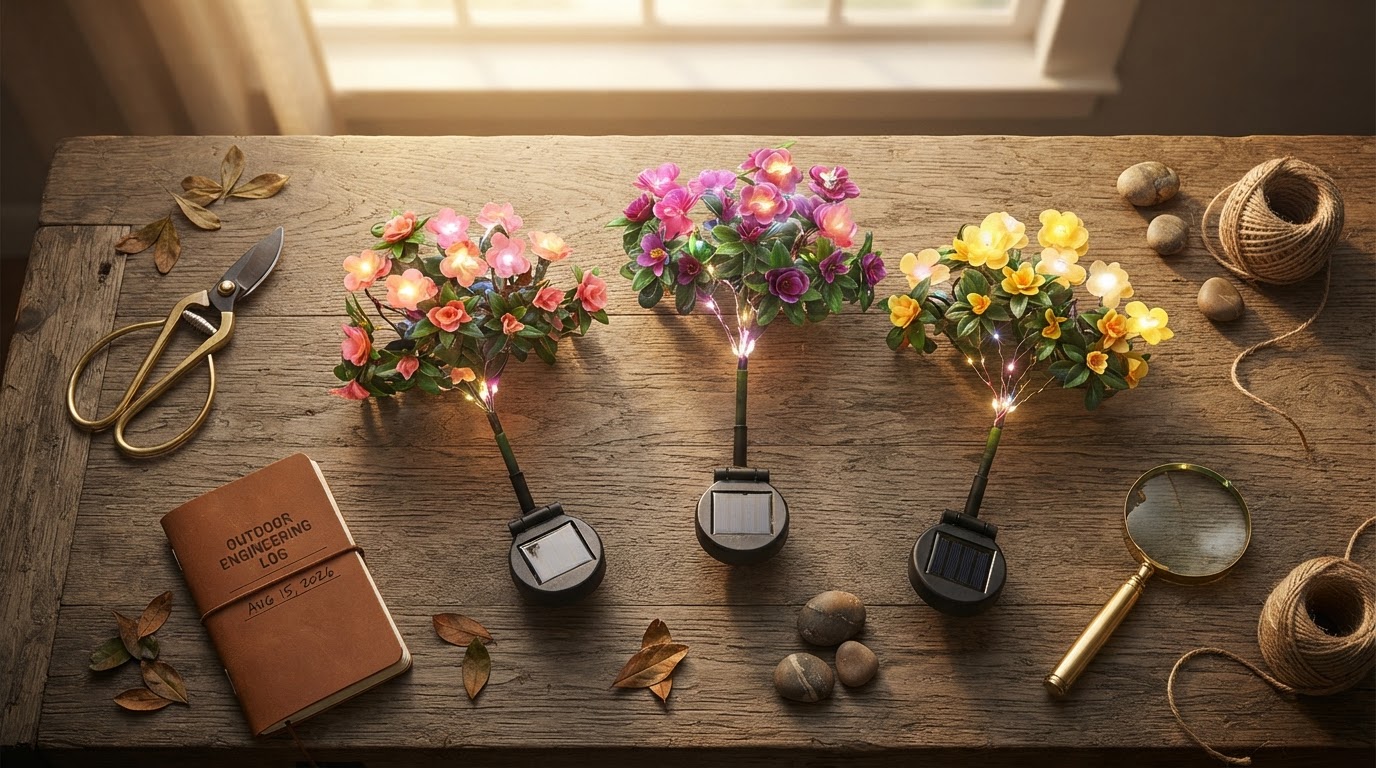
Optimizing Waterproof Solar Landscape Flowers Performance
 Maya ChenContributing Editor
August 15, 2026. This report examines the durability and efficiency standards required for waterproof solar landscape flowers intended for long-term outdoor deployment. It is written for property owners prioritizing hardware longevity over seasonal aesthetics.
The Engineering Reality of Outdoor Floral Lighting
The conventional wisdom says that any lighting fixture labeled for outdoor use can withstand the rigors of a standard garden environment. Here's the part nobody talks about: the vast majority of consumer-grade solar stakes fail not because of battery exhaustion, but due to capillary action and seal degradation in the stem assembly. Most products marketed as waterproof solar garden decor utilize basic silicone gaskets that expand and contract at different rates than the plastic housings they are meant to protect. When thermal cycling occurs—shifting from midday heat to evening cooling—micro-gaps form, allowing moisture to reach the internal circuitry. This leads to the rapid oxidation of solder joints, a phenomenon frequently discussed in Reddit communities regarding realistic solar flower stakes. While many manufacturers promise years of service, the actual lifecycle in high-humidity regions often drops below six months. The industry consensus suggests that simple water resistance is sufficient, yet for a fixture to remain functional throughout varied precipitation cycles, the ingress protection must account for both vertical rainfall and the moisture rising from the soil itself.
Technical Specifications of Solar Azalea Lights
Photo by ROMAN ODINTSOV on Pexels
Solar Azalea Lights address these systemic failure points by utilizing a high-density polymer construction that minimizes the number of mechanical seams. Unlike generic artificial flower solar stakes for yard that rely on glued fabric petals, these units integrate the solar cell directly into the foliage structure to reduce exposed wiring. Based on search console data, consumers are increasingly seeking pink solar flower lights that do not fade under UV exposure; the pigment stabilization in these azalea models is specifically engineered to resist the bleaching effects of direct sunlight. The internal power management system is housed in a sealed compartment that exceeds standard moisture-wicking benchmarks. By centering the design on the azalea form factor, the product provides a larger surface area for the solar panel without increasing the mechanical footprint of the stake. This design choice directly impacts the recharge rate, ensuring that the everlasting flower garden lights maintain their luminosity through the early morning hours, rather than dimming shortly after midnight. The focus here is on hardware reliability, ensuring that the aesthetic appeal of the pink floral design is backed by a chassis capable of surviving a standard North American winter.
Deployment and Selection Framework
Photo by 🇻🇳🇻🇳Nguyễn Tiến Thịnh 🇻🇳🇻🇳 on Pexels
When selecting solar lighting for a permanent landscape installation, the decision should be based on technical resilience rather than initial visual impact. To ensure the longevity of your installation, follow this deployment checklist:
- Verify the IP (Ingress Protection) rating specifically for the battery housing and the LED junction.
- Assess the stem material for corrosion resistance, prioritizing stainless steel or treated polymers over painted iron.
- Examine the solar panel coating; monocrystalline panels with tempered glass or high-grade ETFE film last significantly longer than epoxy-potted alternatives.
- Check for a manual override switch that is protected by a rubber boot to prevent moisture entry during operation.
- Evaluate the stake depth to ensure stability in saturated soil conditions, preventing the light from tipping and submerging the electronics.
Shop Solar Azalea Lights here.